Jessy's Well
Designed to Last
Monday, May 4, 2026 by Jessy Granviel
Categories: Writing Updates
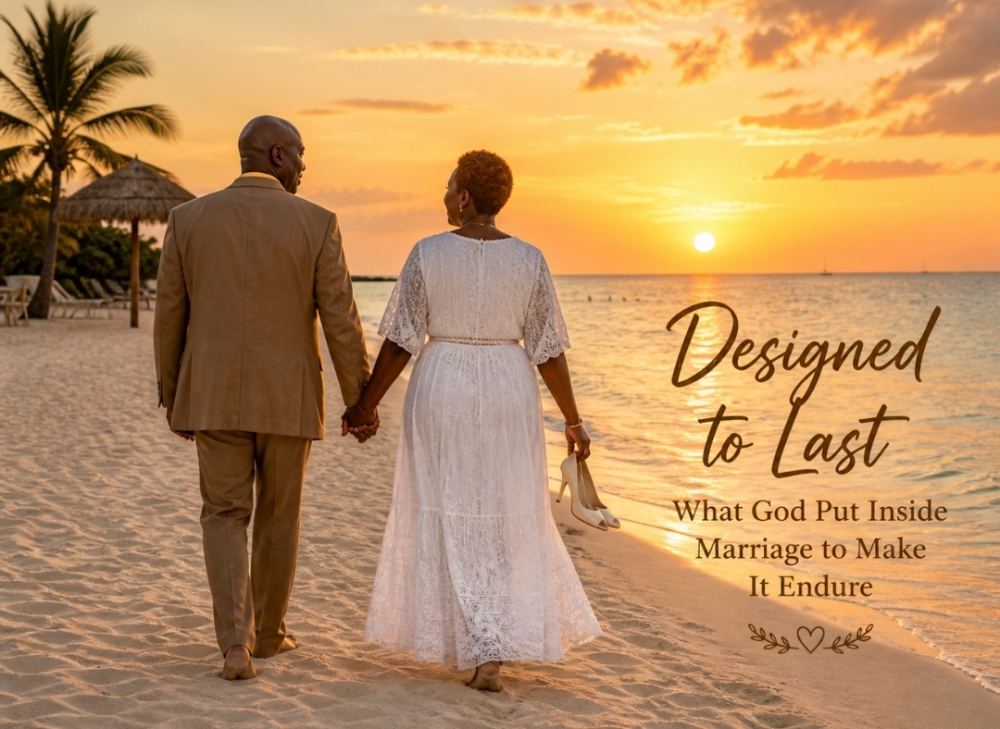
Little girls in the generation before mine used to drape pillowcases over their heads and practice walking down the aisle. By the time I came along, things had already changed.
In our teenage years, careers were the new ambition. Me? I didn’t hesitate: I want a good man who will love me, marry me, and build me a house. My whole ambition, right there. My peers had an opinion about that answer: “I was either weird or hot.”
My dream was never just about the wedding. It was about the whole life after it.
Things Changed
There is a shift in the way we think and speak about marriage. There are many conversations about what it takes to make it work — and they are not wrong. But underneath them sits a quiet assumption that it may not. That marriage is fragile and unpredictable. Almost as if endurance is luck, not design.
That’s worth pausing over.
Marriage can be hard. People experience disappointment. Strain. Abuse. Moments where things do not unfold the way they expect. What I’m saying here is not a call to stay no matter what and do nothing about it. Nor is it meant to place weight or judgment on those whose marriages did not last.
The intention is to keep reality from redefining what was originally designed.
The Correction
The fact that lasting marriage feels uncommon today does not mean it is impossible. It means what makes it last is misunderstood.
We have watched enough marriages not last that we have quietly started to believe that the ones that do are the lucky ones. That something extraordinary happened to them.
Endurance in marriage is not a rare exception. It is the original design.
God instituted marriage and called it a covenant. The words covenant and marriage are not often mentioned together in the Bible. Yet the concept runs through all of it, in the language of joining, one flesh, witness, and permanence. (Malachi 2:14)
Both secular and biblical dictionaries agree on this much: a covenant is solemn, formal, and binding. Not casual. Not conditional. Not up for discarding.
God called marriage a joining — two becoming one flesh. Not two independent paths that may or may not stay parallel. That is not the language of something fragile. But of something built to hold.
What the Design Contains
If marriage was meant to hold over time, then everything inside the design makes that possible.
When there is a disconnect between God's design and how it is lived, what was meant to hold can begin to feel unstable. Expectations. Thought patterns. The way two people relate to one another over time. These things shape the experience of what was designed.
Marriage contains more than one ingredient — covenant commitment, sacrificial love, forgiveness, honor, God at the center, and companionship. Each one matters.
But before God joined them, before the covenant, before the ceremony — He noticed something. It is not good for man to be alone. That observation was not just the reason He created Eve. It was the reason He established marriage. I call it companionship. Companionship was not added to the design. It was the design's very beginning.
When Companionship Drifts
God gave the first groom a partner to complement him. To make him whole. Someone to walk with. Someone to build with. Someone to face life alongside. That is where companionship begins — as a purpose, not just a feeling.
When companionship is no longer lived according to its purpose, two people can be present and still be alone. Not walking together. Not building together. Not facing life together. The marriage begins to feel what the design was never meant to feel. Stuck. Strained. Fragile. Not because God's design failed, but because one of its most vital ingredients is no longer functioning.
Here are some lessons five decades of partnership in matrimony taught us.
1. Companionship Begins with a Decision
Companionship is a choice. One that begins before the wedding day and is sealed on it. What you do on the day you say "I do" matters. But so does every day after.
We discovered this early. He chose me, and I chose him. The more we did what we both loved — dancing, being out in nature, joking, and having meaningful conversations, the stronger and more enjoyable our marriage became.
We also built things together, household rhythms, shared practices, principles we both agreed to live by. And then came the hard work: learning to enjoy what we didn't share, or accepting what we didn't, and giving each other room for it.
That is the choice. Not once. Every day.
2. Companionship Is Built Over Time
Life happens. You grow. You adjust. You serve one another. And part of that growing is learning to see who you actually married. not who you imagined you married.
You stop trying to change them. You start discovering who they actually are — and you team up with that person instead.
You may have wanted the flowers-and-anniversaries man. The one who remembers every date, who expresses everything with grand gestures. But you married the practical, deeply caring, quietly present man. One who may not bring the flowers. but who is always there. The one you can lean on in every situation.
Companionship requires you to see what he actually offers, receive it, and fill what is missing from other sources — friendships, community, your sisters, God Himself.
A husband was never meant to be everything. Companionship has a lane. When you understand that, you stop resenting him for not being something he was never designed to be.
3. Companionship Was Designed for Fullness
God did not create companionship just to solve loneliness. He built something much richer into it from the very beginning.
He gave the first couple work to do together — tending the garden, building something, stewarding what He had made. Purpose, not just presence. He gave them the world to enjoy together, which means companionship was always meant to include delight, not only duty. And He gave them the capacity to give each other pleasure, which means intimacy, in every sense, was written into the design from the start.
This was not a survival arrangement. It was a full life, shared.
I sometimes wonder when it happened — that point when we could just drive together in silence, each in our own thoughts or in none at all and still feel completely connected.
It became a constant, something that now defines our marriage, though I can't say when it began. In that quiet there is a deep sense of security where nothing needs to be proven, a natural integration of our lives, and an ease of presence without pressure to speak or perform. Even silence carries connection, not distance. To me, that steady companionship feels like fullness, as if it were designed to make us whole.
That is what healthy companionship looks like. It overflows and creates a deep, quiet sweetness, an ease of connection, and a natural bond between a couple.
4. Companionship Gets Tested and That Testing Is Part of the Design
Things will come. And they will come to test your companionship. They will try to break it.
When the hard things arrive, the right posture of a marriage built on companionship, even unspoken, is this: “we face this together.” It will not split us. We decided to walk together, and that includes this.
What was meant to break your marriage can actually strengthen it — when God remains at the center.
You discover what you are capable of as a team. You do not just survive it. You bond through it. You come out the other side knowing each other in ways you could not have known any other way.
That is not luck. That is how it was meant to work.
5. Companionship Leaves a Legacy
Companionship in a marriage does not stay between two people. It leaves something behind.
A legacy that continues in the next generation — children and grandchildren who grew up watching two people choose each other, again and again—learning what it looks like to walk together through a whole life and carrying that picture into their own homes.
That is companionship that has outlived itself. And it is one of the most powerful things a marriage can produce.
Back to the Design
Endurance in marriage is real. Not because some couples are fortunate or extraordinary. But because God designed it to endure
Marriage wasn’t established to limp along or to be abandoned. He intended it to hold and to be enjoyed. He built fullness into it from the very beginning. Purpose. Delight. Intimacy. A whole life, shared. That was always the intention.
And when a couple upholds their part, choosing each other daily, building over time, seeing who they actually married, facing the hard things together — the design does what it was always meant to do. It endures. It fills. It overflows. It leaves something behind worth inheriting.
You may be in a season where your marriage feels anything but designed. Where endurance feels impossible and companionship feels distant.
This is not written to condemn that reality. It is written to remind you that the design has not changed. What God put inside marriage is still there. Still available. Still working — and still capable of becoming something fuller and more enjoyable than you may have stopped believing it could be.
“But whoever drinks the water I give them will never thirst. Indeed, the water I give them will become in them a spring of water welling up to eternal life.”
John 4:14 (NIV)
Previous Posts
Carrying vs. Caring
Jessy Granviel
7/21/2026
When the small and overlooked rise
Jessy Granviel
6/14/2026
Designed to Last
Jessy Granviel
5/4/2026
The Kind of Growth God Notices and Honors
Jessy Granviel
3/26/2026
Christ in Hard Times - Part 1
Jessy Granviel
12/18/2025
Christ in Hard Times - Part 2
Jessy Granviel
12/18/2025
From “Mess” to Rest
Jessy Granviel
12/12/2025
Introducing Jessy’s Book – "Oh My Child"
Jessy Granviel
6/1/2025
Introduction: Dare to Model Christlike Compassion
Jessy Granviel
5/10/2025
